PFIC Colors: Making Sense of PFIC with the PFIC Network
Progressive Familial Intrahepatic Cholestasis (PFIC) can be a complex condition. Finding trusted information about PFIC shouldn’t be. PFIC Colors is designed to help families make sense of these conditions and find the information and support they need, fast.
Progressive familial intrahepatic cholestasis (PFIC) is a group of rare inherited liver conditions that can affect people in different ways.1,2 Symptoms, how the disease progresses and the treatments needed can all vary depending on the different types of PFIC.1
This complexity means PFIC can be difficult for families to understand, especially in the early stages after diagnosis. Families facing a PFIC diagnosis often describe the early days as overwhelming, confusing, and isolating. The condition’s complexity and variable presentation from person to person can make it difficult for families to understand and find information that reflects their lived experience.
It can be a lonely and confusing time, filled with questions and uncertainty. In these moments, having access to trustworthy, community-developed resources can help bring clarity and light to what may otherwise feel like a daunting situation. This is exactly what families can find on the PFIC Network website.
.
Understanding PFIC through color
To help people navigate their way to factual, accurate and supportive information, Ipsen has joined with PFIC Network to develop an engaging and positive campaign that reaches out through digital channels, including social media, to find people who are searching for information on PFIC. Engagement is encouraged with the content using the positive, inspiring and simple concept of talking about PFIC as a disease of many colors.
This color‑inspired initiative is designed to help make sense of PFIC’s complexity by guiding families to the full spectrum of resources available on the PFIC Network website. It aims to bring color back into people’s lives through clearer, more accessible information and meaningful connection with a community that understands their lived experience.
The importance of clarity, connection and community
Emily Ventura, co-founder and executive director of PFIC Network and mother to Cedar, who lives with PFIC, has experienced firsthand how challenging the early stages of diagnosis can be.
Emily shares more about this initiative in the video below, reflecting on why bringing clarity, connection and community to PFIC families is so important.
“When my daughter was diagnosed [with PFIC], back in 2012 we were not given any resources or contacts with any community for support, none existed yet. That left us feeling lonely, isolated and fearful of her diagnosis.”
As Emily connected with other parents who were going through similar experiences, it became clear that many people were navigating PFIC without guidance or support. These shared realities led to the creation of PFIC Network, now a global community offering the full spectrum of trusted information and connection for people living with PFIC and those who care for them.
.
Explore the Colors of PFIC
The PFIC Colors approach is designed to help families navigate PFIC in a clearer, more accessible way. By organizing information into six colour‑coded topic areas and grounding every section in lived experience, the PFIC Network helps families feel more confident and in control as they navigate their PFIC journey.
If you wish to find out more about PFIC, click on the individual topic boxes below to visit the dedicated section of the PFIC Network’s website to learn more.
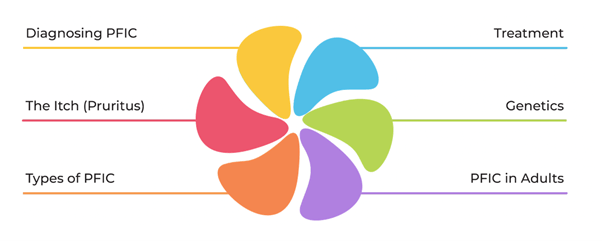
Diagnosing PFIC
PFIC is usually diagnosed in infants and young children, but also in teens and adults too. At first, you may feel scared, isolated and unsure where to turn – these feelings are normal.
The Itch (Pruritus)
Symptoms can have a huge impact on day-to-day life but can be managed. One of the most common is extreme itch (pruritus).
Types of PFIC
There are currently 13 known types of PFIC, each caused by changes in a different gene. While may symptoms overlap across PFIC types, each type has distinct features that set it apart. More types are being discovered regularly, helping us understand PFIC better and, ultimately, improve care.
PFIC in Adults
PFIC is typically diagnosed in children, but it can affect adults too, sometimes after years of unexplained liver symptoms. It may present differently than in children, which can make diagnosis challenging. Understanding adult experiences with PFIC can help you find the right support and care.
Genetics
PFIC is inherited, meaning it’s passed down through families. Even with the same type of PFIC, people can have very different experiences depending on the specific changes – or mutations – in the gene involved. New mutations are being discovered all the time, helping shape how PFIC is diagnosed, understood, and managed.
Treatment
There are different treatment options to consider, from medications to surgery and liver transplant. Talking about these with your doctor can help you understand the best one for you or your child.
Visit PFIC.org, or your local PFIC group, for the full spectrum of information about PFIC.
This campaign was developed together by Ipsen and PFIC Network.
Please find below links to patient advocacy groups from the PFIC International Alliance:
| Group Name | Website & Social Links | Email Addresses |
PFIC Advocacy and Resource Network  | 🌐 PFIC.org 📷 @pficnetwork | info@pfic.org |
PFIC Pakistan | zuneradilshad1985@gmail.com | |
PFIC Italia Network  | 📘 Facebook 📷 @pficitalianetwork | pficitalia@hotmail.com |
PFIC Network Deutschland | 📘 Facebook 📷 @pficnetworkdeutschland | adaminikolina@gmail.com |
PFIC Network Polska  | pficnetworkpolska@gmail.com | |
PFIC & Related Disorders Australia/New Zealand  | 🌐 pficrdaustralia.org 📷 @pficrdausnz | melanie@pficrdaustralia.org |
PFIC Brasil | 📘 Facebook 📷 @pficbrasil | N/A |
PFIC Canada  | N/A | Walter@pfic.org perez.alexandra@hotmail.com |
.
References
[1] Baker A, et al. 2019. Systematic review of progressive familial intrahepatic cholestasis. Clin Resh Hepatol Gastroenterol. 43(1):20-36.
[2] Mighiu C, et al. 2022. Impact of progressive familial intrahepatic cholestasis on caregivers: caregiver-reported outcomes from the multinational PICTURE study. Orphanet J Rare Dis. 17(32):1-12.
How useful was this post?
Click on a star to rate it!