We are pleased to announce that Ipsen’s 2025 Sustainability Statement – our annual publication outlining Ipsen’s environmental, social and governance (ESG) commitments, progress and priorities – is now available on our website, reflecting our commitment to maximize positive change for future generations.
This publication marks an important milestone in our ESG journey. It is the result of a collective effort, bringing achievements building a more sustainable future for patients, people, and society.
Over the course of seven months, more than 140 colleagues across lots of functions contributed to bringing this report to life. Spanning 230 pages, it reflects the depth of our ambition, supported by 407 KPIs and strengthened by audits conducted across three sites and Corporate functions.
Together, this work showcases not only our progress, but also the scale of collaboration and rigor behind our sustainability journey.
.
A Strengthened Report Reflecting Our 2025 Progress
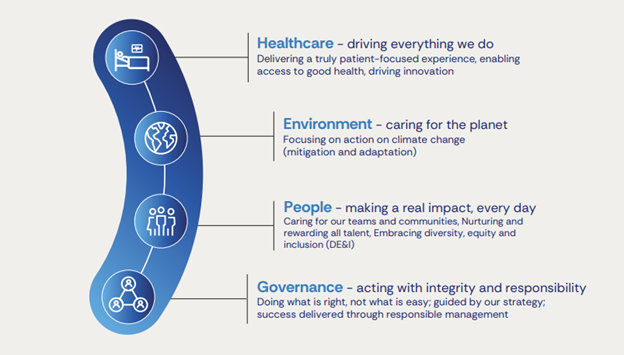
This year’s edition provides a clear overview of the progress we have made in 2025, the challenges we continue to address, and the priorities guiding our journey ahead. It is structured around our four strategic pillars..
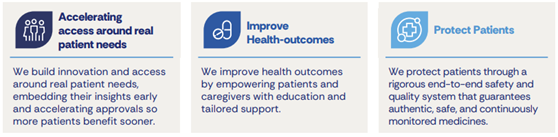
Healthcare key highlights
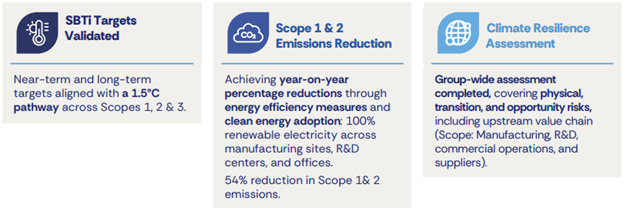
Environment key highlights
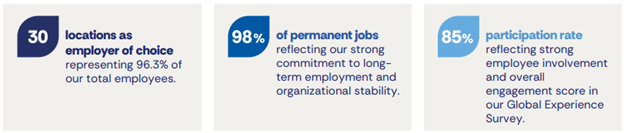
People key highlights
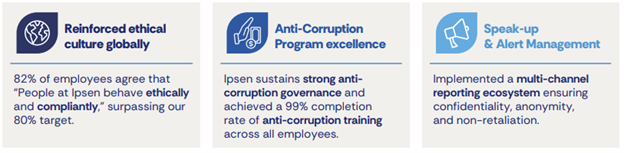
Governance key highlights
.
Looking Ahead to 2026: Building on Strong Momentum
The progress captured in this year’s Sustainability Statement shows how far we have come – and how much we can still achieve together.
As we move into 2026, we do so with strong momentum, renewed ambition, and a shared commitment to continuing our sustainability journey. Beyond our environmental objectives, we remain focused on being an employer of choice, fostering a strong ethical culture, and protecting patients through robust, end-to-end safety and quality systems. By working collectively across the organization, we continue to build a , more resilient, and more inclusive company – creating long-term value for patients, employees, and society.
Mary Jane Hinrichs, Global Head of Early Development
Redefining the next chapter of cancer innovation
Working in early development, I have the privilege to see the next generation of therapeutic science take shape – and few areas are more compelling than immuno-oncology (I-O). From first data points in the lab to breakthroughs in the clinic, it is clear that we are entering a new era with the potential to deliver transformative outcomes for patients.
That progress reflects a deepening sophistication – not only in our understanding of the immune system and its interaction with cancer, but in how we respond to real-world challenges faced by healthcare professionals, patients and families. Despite significant I-O breakthroughs, patient responses remain variable and immune-related toxicities widespread, underscoring the need for more refined and targeted approaches.1
From ‘releasing the brakes’ to targeted approaches
First-generation I-Os showed that releasing the brakes on immune cells can drive meaningful responses, but also exposed the limits of broad immune activation. These learnings are now shaping next-generation approaches that engage the immune system more precisely: targeting specific pathways and cell types for a more coordinated, tailored immune response.2
By coordinating the immune systems rapid front-line defenses and it’s more targeted, lasting response, these emerging therapies have the potential to deliver deeper anti-tumor activity while carefully managing safety.2,3
It’s this promise that shapes how we work at Ipsen. Grounded in precision, selectivity and deep cancer biology insight, we are advancing a growing I-O pipeline, spanning solid tumors and blood cancers with T cell engagers, T cell activators together with targeted antibody-drug conjugate therapies. I am especially driven by how next generation I-O approaches has the potential to deliver better tolerated options to patients living with acute myeloid leukemia, where unmet need remains so high.
Looking ahead
The pace of progress in I-O is remarkable, but the measure of success isn’t scientific sophistication. It’s whether that precision reaches patients living with cancers like AML, where current options remain inadequate. The tools are becoming sharper. The question now is how fast we can close the gap.
Yin Q, Wu L, Han L, et al. Immune-related adverse events of immune checkpoint inhibitors: a review. Front Immunol. 2023;14:1167975. Published 2023 May 25. doi:10.3389/fimmu.2023.1167975
Garg P, Pareek S, Kulkarni P, Horne D, Salgia R, Singhal SS. Next-Generation Immunotherapy: Advancing Clinical Applications in Cancer Treatment. Journal of Clinical Medicine. 2024; 13(21):6537. https://doi.org/10.3390/jcm13216537
Li C, Yu X, Han X, et al. Innate immune cells in tumor microenvironment: A new frontier in cancer immunotherapy. iScience. 2024;27(9):110750. Published 2024 Aug 17. doi:10.1016/j.isci.2024.110750
Nick Gagnon, Vice President and Head of Late Stage Partnering
Why late-stage partnering demands a clearer lens
Late-stage partnering is unforgiving — high-stakes, capital-intensive, and fiercely competitive. The cost of a poor partnership isn’t just financial; it’s the lost opportunity to advance a program that could have changed patient outcomes but didn’t get the right partner at the right moment.
Without a purpose-driven philosophy, even well-resourced organizations risk chasing novelty over impact and deal volume over value. That is the trap Ipsen is deliberately designed to avoid.
Ipsen’s strategy: purpose as a competitive differentiator
For us, partnering starts with purpose. We focus on impact, asking “is this science truly transformational for patients?” and “are we the right organization to accelerate it?”. Underpinned by this purpose, we apply a filter that is intentionally demanding, looking for strong scientific rationale with the potential to redefine standards of care. That calls for partners who, at their core, share our ambition and conviction, whilst aligning with our therapeutic expertise and infrastructure across Oncology, Rare Diseases, and Neuroscience.
This past year, I have continued to see the clarity of this partnering strategy come to life. The decisions we have taken haven’t always been easy, but we have stood by our principles, ensuring we stayed committed to programs with the highest potential for meaningful patient impact.
The future of biopharma collaborations
The future of partnering lies in intentional, high‑quality decisions. At Ipsen, we’re focused on whether the programs we champion reach patients who need them, and that our involvement meaningfully accelerated that outcome.
Patients don’t feel the impact of the deals we sign — they feel the medicines that reach them. And that is what science with purpose looks like in practice.
For many people at Ipsen, the impact of their work becomes clear through patient stories, scientific breakthroughs, or moments shared with colleagues. For Emilie Manier, Senior Executive Assistant, that realization came in a much more unexpected situation: a dinner with friends.
Emilie joined Ipsen in 2022 and works in the international team, supporting the Executive Vice President, Head of International and coordinating teams across different countries. As a Senior Executive Assistant, she helps with organization tasks for the team to facilitate collaboration, and enable leaders to focus on key priorities. While she doesn’t work directly with patients, as an integral part of team she helps empower leaders and teams to make decisions that ultimately impact people’s lives.
Emilie recalls the moment everything clicked about the impact of her work at Ipsen. An evening, during a casual dinner with friends, the conversation turned to health. One of her friend mentioned that her doctor had prescribed a treatment. An Ipsen treatment.
“I was like, ‘Oh, this is real, actually.’”
Another friend at the table then shared that she had also taken an Ipsen treatment. In that moment, Emilie realized that the people benefiting from Ipsen’s medicines are not just distant patient stories. They can be the people sitting right across from you.
“Being there at that table, hearing people talk about our treatments made me feel incredibly proud,” she says. “I felt really grateful to work for a company that truly impacts people’s lives.”
For Emilie, that evening was a powerful reminder that every role contributes to Ipsen’s mission. Even behind the scenes, helping teams collaborate and make decisions ultimately supports a shared goal: improving patient’s lives.
New in our A Life in Science series, we hear from Audrey Clapéron, Translational Biology Director, about the essential role of data in driving discovery forward. She shares how leading a team of pharmacologists and delivering high-quality evidence for clinical development keeps her motivated and close to the patients who may one day benefit.
“Data are clearly at the basis of everything. They provide evidence for decision-making in an objective way, and so they are very important for the project,” says Audrey Clapéron, Translational Biology Director at Ipsen.
Her work centers on ensuring that projects are driven by reliable results. “My everyday life is to make sure that all the pharmacological data are provided to the project. I’m also leading a team of in-vivo and in-vitro pharmacologists.”
Those data are not abstract—they are essential to moving discoveries forward. “We are very close to the patient because we are providing evidence and data for clinical development, and so the patients are almost right here.”
That sense of closeness to patients drives how Audrey and her team handle challenges. “When things get complex and challenging, I always come back to the key priorities for the project—to provide new, innovative medicine to the patients, make some prioritization if needed, communicate with the team, and provide a vision so they can work efficiently for the project to move forward.”
Audrey’s perspective highlights why data are more than information—they are the evidence that allows medicines to progress, with patients always in sight.
“We’re doing real science. For real people. And we’re doing it together. That’s what matters most to me.” – Alison Mason
The science behind cell culture and fermentation rarely makes headlines. But without it, no treatment would reach a patient. Alison Mason knows this better than most. She leads the cell line and upstream process development team and provides chemistry, manufacturing, and controls (CMC) leadership to support the biologics pipeline at Ipsen, helping turn early-stage science into ready-to-use clinical material.
Her work at Ipsen’s Wrexham site includes one of the company’s largest clinical development programs. “It’s a complex molecule, and we manufacture it in-house,” she explains. “We’ve developed the process from early development through to late-stage clinical production.”
Alison’s role blends precision and persistence. “You need to make sure the yield is right. The quality is consistent. That each batch can be trusted. And when something’s off, you fix it—not alone, but with the team.”
This mindset carries into her work on partnered assets too. She leads CMC input for several discovery-stage oncology candidates, including those from Ipsen’s collaboration with Marengo Therapeutics. “The partnership is really energizing,” she says. “We bring complementary skills to the table, and the science is pushing boundaries.”
What Alison values most are the people who work together to make Ipsen innovation happen. “You can have the best plan, but without the right people, it goes nowhere,” she says. “Here, at Ipsen, we have a team that shows up for the work and for each other.”
New in our A Life in Science series, we hear from Mary Jane Hinrichs, Senior Vice President and Head of Early Development, about her path from discovering a passion for pharmacology to leading drug candidates through first-in-human trials. She shares how balancing strategy, science, and a constant focus on patients motivates her to shape the future of medicines.
“I was inspired to get into science from a love of learning about how drugs impact the body,” says Mary Jane Hinrichs, Senior Vice President and Head of Early Development at Ipsen. “To be quite honest, when I was in early undergrad, I did not ‘love’ the basic hard science. And it was really one day when I took a course on pharmacology and I could see how chemicals, when they go in the body, have such an impact on our day-to-day lives. It was fascinating for me, and I was so excited to be able to pursue a career in this.”
Mary Jane’s work today is about taking drug candidates into early human trials. “My role at Ipsen as Head of Early Development is to take promising drug candidates through to early clinical proof of concept. And so, what that means is that we take the most promising modalities that we look at through external partners and shape them and develop the strategy to test them in humans for the first time.”
She has seen discoveries with both challenges and breakthroughs. “We had an asset that had amazing pharmacology that did something that nothing else that we’ve seen before has ever been able to do. The issue with it is that it had properties that made it so that it wasn’t going to be able to be orally available… we were able to transform it into a formulation that we could get benefit out of it, and it’s now in patients and doing very well.”
For Mary Jane, success in early development depends on one constant: “It is essential to keep the focus on the patient.”
The Ipsen S.A. 2026 Annual General Meeting will take place on 13 May 2026, in Paris, France at 3 pm at the Salons de l’Hôtel des Arts et Métiers, 9 bis avenue d’Iéna, 75116 Paris.
New in our A Life in Science series, we hear from Elodie Lewkowicz, Asset Lead, about how curiosity and collaboration drive her mission to tackle the complexity of cancer. She reflects on mentoring, developing the next generation of scientists, and keeping patients at the heart of every data point to stay motivated through challenges.
“You never know what will happen. No day is like the previous one. It’s really about aligning the team on science, on the strategy, and looking at the big picture, the long-term vision,” says Elodie Lewkowicz, Asset Lead at Ipsen.
Her work in oncology is driven by curiosity for how biology works at its most intricate level. “I like understanding how things work, how this complexity actually can be very simple. For instance, how a single point of mutation can change the fate of a cell and to become cancer cells.”
That drive is combined with a deep belief in teamwork. “Working in collaboration, to me, it’s essential. I don’t think that in science you can do it on your own. You need the knowledge, the expertise, but also the different way of thinking.”
For Elodie, the purpose behind the science is never abstract. “When I look at data, I see patients behind the data and that’s where I keep the motivation.”
Her vision is that curiosity, collaboration, and patient focus are what allow science to meet the challenges of cancer and bring new possibilities forward.
An article by Dr Marius Tham, Director Global Medical Affairs, Ipsen
The European Neuroendocrine Tumor Society (ENETS) 4 – 6 March 2026 conference in Kraków is one of the most important moments of the year for the global NET community. Clinicians, researchers, nurses, advocates and partners come together with a shared purpose to expand understanding of neuroendocrine tumors (NETs) and improve care for people living with them.
ENETS is unique in its ability to bring every part of the oncology ecosystem together in one space. For Ipsen, it’s an opportunity to listen, learn and contribute. It is also a reminder of the complexity of NETs, a type of cancer that can be difficult to diagnose, can progress unpredictably and requires thoughtful, multidisciplinary approaches to treatment and long‑term care. These challenges highlight why partnership across the community remains essential.
This year marks 40 years of Ipsen’s commitment to oncology: a milestone that reflects our long-standing involvement in advancing scientific knowledge and supporting patients, healthcare professionals and the wider community dedicated to oncology care. Over the years, we have built a respected reputation, shaped by collaboration, scientific exchange and a shared desire to move the field forward. We’re proud of everything we’ve achieved together however, we know there is still further to go
At ENETS 2026, Ipsen will be actively engaged in dialogue, offering scientific insights and connecting with healthcare professionals to better understand their needs. Delegates can expect meaningful conversations, practical resources and opportunities to share perspectives that help shape future initiatives. These exchanges provide a valuable foundation for improving care long after the congress concludes and allow us to reflect on past progress while accelerating the collective work that lies ahead.
As we prepare to join colleagues and partners, we do so with excitement, purpose and optimism. We look forward to the conversations, the insights and the collaborations that will define ENETS 2026, and to continuing our shared mission to advance the science of NETs together.
You are now leaving the Ipsen group global website. To continue, please click on Continue?
We value your feedback
How easy was it to navigate Ipsen website and locate the information you were seeking?